
A football may be the cheapest part of the afternoon. Someone must keep the facility open, make the journey safe, welcome the newcomer, explain the rules and ensure a child can return next week. If one of those things is missing, the promise that sport is “for everyone” can collapse before anyone takes the field.
We love the story of the young athlete who finds a coach and changes their life. It is a compelling story because it contains real possibilities. But a single success can hide the people who never reached that first training session, the families priced out by transport and the participants who stopped coming because they did not feel welcome. Sport can open doors. It can also reproduce the barriers outside them.
An inclusive sports program cannot be judged only by its most successful graduate. It must also be understood through the children who could not afford to join, the teenager who left after discrimination, the athlete who found a safe place to belong without ever winning a trophy and the volunteer who kept a community connected through difficult years.
The promise of sport is substantial. It can create friendships across social boundaries, physical activity, routines, role models and access to new networks. But sport takes place inside society. It does not erase poverty, racism, housing insecurity, disability barriers or unequal education by magic. It can reproduce those inequalities as easily as it can challenge them.
A ball is not a social policy
A football pitch in a disadvantaged neighborhood can be a valuable public asset. But its existence alone does not guarantee participation. Children need safe access, available coaches, appropriate equipment and the time to play. They may also need transport, disability accommodations, reliable meals or a family able to support attendance.
The World Health Organization’s physical-activity guidelines describe meaningful health benefits associated with regular movement. That public-health value supports investment in accessible sport. Yet it is a different claim from saying that participation will reliably produce employment or escape from poverty.
Programs should state their goals honestly. If the objective is more regular activity, measure participation and retention. If the objective is social connection, ask whether newcomers develop relationships and feel welcome. If the objective is educational support, track educational outcomes while acknowledging that many influences lie beyond the program.
Community matters before extraordinary achievement
A local club may never produce a professional athlete. It can still be one of the most important organizations in a neighborhood. Its value can lie in predictable gathering places, intergenerational relationships, shared responsibility and moments of pleasure in lives otherwise marked by uncertainty.
Volunteers often create this value without recognition. They open facilities, organize transport, resolve disputes, welcome families and make training possible week after week. Their work is social infrastructure, even if it does not appear on a league table.
Clubs should learn to describe these outcomes with dignity. A child should not have to be rescued by sport to deserve participation. Sometimes the benefit is simply a joyful afternoon and a place where their name is known. That is already meaningful.
Opportunity is distributed unevenly
Aspen Institute Project Play research in the United States documents persistent participation gaps between children from different household income groups. The gap is not a universal global statistic, but it is a reminder that opportunities to play are shaped by resources. Similarly, the Australian Sports Commission reports associations between household income and the frequency of organized sport participation.
The mechanisms are practical: entry fees, travel, equipment, location and time. A scholarship may cover one cost while leaving another untouched. A program might be described as open to all but scheduled when working parents cannot bring children.
Sporting institutions should map barriers before assuming they have solved them. Ask who is missing from registration data, how people learn about the program and why families stop attending. If a service is genuinely accessible, the evidence should be visible in the diversity and continuity of participation.
Belonging takes more than putting people in the same uniform
A team can bring together athletes from different neighborhoods, languages and backgrounds. That opportunity is valuable, but proximity does not automatically produce respect. Discrimination may appear in jokes, unequal playing time, assumptions about ability or the refusal to take complaints seriously.
Coaches and club leaders need clear standards. Athletes should know how to report concerns. Staff need to respond without retaliation or dismissive language. A newcomer should not be required to surrender their identity to earn acceptance.
The goal is not to eliminate differences, but to create relationships in which differences do not determine who is heard or valued. A team can teach cooperation only if its own decisions demonstrate that cooperation matters.
The professional pathway is not the only success story
Elite sport attracts attention because it provides dramatic outcomes. The participant who becomes a professional may earn income, travel or gain educational opportunities. But the majority of young participants will not enter that profession. A program that defines success only by elite promotion risks neglecting the people it was supposed to serve.
Alternative outcomes deserve serious consideration: staying physically active into adulthood, becoming a volunteer coach, completing education, developing friendships, discovering a profession in physiotherapy or finding a healthy relationship with competition.
Some of these outcomes are difficult to quantify. That does not make them imaginary. Evaluation can combine attendance data with participant interviews, family feedback and longer-term follow-up. The important point is to define what the program can reasonably influence and to avoid claiming causality from inspiring anecdotes.
Can sport help people move between social worlds?
Sport can create connections that a young person would otherwise never encounter: coaches, clubs, universities, local employers and peers from different backgrounds. A trusted mentor may help someone understand an unfamiliar institution or opportunity. Shared activity can make a first conversation easier.
But networks can also become exclusive. Private academies, expensive travel tournaments and invitation-only spaces may reinforce existing advantages. The same sport can therefore be a bridge for some participants and a barrier for others.
Institutions can respond by making introductions intentional and transparent. Offer career talks, educational guidance, mentoring and open events alongside competition. Ensure information about opportunities does not circulate only through well-connected families.
Safeguarding is not optional in social-impact sport
Programs working with vulnerable children or families can unintentionally present themselves as benevolent exceptions to ordinary professional standards. That is a mistake. Every participant deserves appropriate safeguarding, privacy, trained staff and clear boundaries. Good intentions are not a substitute for accountability.
Coaches may become trusted figures, but they should not take on responsibilities for which they are not qualified. When a child needs social, clinical or legal support, a responsible program connects them with appropriate services rather than turning a sports relationship into a private rescue mission.
People should also retain the right to leave. An athlete who chooses another activity must not be portrayed as ungrateful. Social inclusion is genuine only when participation remains a choice.
What communities should demand from a sports project
- Clear objectives beyond publicity photographs and individual success stories.
- Transparent fees, schedules, admission processes and support arrangements.
- Safe facilities, trained adults and effective safeguarding.
- Opportunities for people of varied abilities and backgrounds to participate meaningfully.
- Feedback routes for participants, including those who withdraw.
- Measures of retention, enjoyment and community connection as well as competitive results.
- Partnerships with schools, healthcare services and local organizations where appropriate.
Public and private funders should ask for evidence of sustained value rather than accepting a single famous ambassador as proof that a project works. Honest evaluation protects both participants and resources.
The quieter revolution
Perhaps the most important effect of sport is not always the most visible. A teenager who finds dependable friends, a parent who feels welcomed at a community facility or an older volunteer who remains connected to neighbors may not generate a headline. Yet these relationships help communities function.
Sport can open doors, but the doors must be real: affordable, safe, welcoming and connected to opportunities outside the game. When we design for those conditions, we move beyond the heroic story of a single rescued athlete.
A better question than “Can sport change a life?” is “What must we change so that sport becomes a meaningful opportunity for more lives?”
Designing for a neighborhood instead of a photograph
Imagine a local authority and several clubs planning a sports program in a district where families face difficult transport connections and limited recreational space. A publicity campaign could attract attention, but it would not solve the barriers that determine whether children can attend every week. The more useful starting point is to understand the ordinary journeys participants need to make.
Which facilities are within walking distance? Are they accessible to people with disabilities? What times are safe for teenagers travelling without adults? Can families who work evening shifts bring children to sessions? Which sports are already popular, and which groups have been excluded? The program should be designed around these answers rather than imported as a standard package.
It may be better to invest in a modest, consistent schedule at several local sites than a spectacular event in one central venue. A regular gathering can build trust because people know where it will be and whom they will meet. A single event can inspire, but continuity creates relationships.
The difference between participation and transformation
A funder may ask how many young people attended. That is a valid measure of reach, but not proof of sustained benefit. Ten thousand sign-ups can coexist with high dropout rates. A smaller program may produce stronger relationships and more regular activity. Neither outcome should be judged without knowing the stated objective.
Evaluation can distinguish first contact, repeat attendance, retention, participant satisfaction and appropriate longer-term outcomes. Anonymous feedback may reveal whether newcomers felt respected and why people stopped attending. Care is needed when asking for sensitive information; community programs should not collect more personal data than necessary.
The most difficult question is causal: did participation itself create a change, or were participants already more likely to succeed because of other support? Responsible organizations avoid promising outcomes that their evidence cannot establish. They can report what happened, what they observed and what remains uncertain. That honesty is a strength, particularly when public money or charitable funding is involved.
Sport and employment: possible bridges, not guarantees
Athletes can develop skills that may also be valuable outside sport: organizing a team, managing time, communicating under pressure and learning how to respond to feedback. But it would be misleading to claim that playing a sport automatically produces employment. Skills need to be recognized, translated and combined with access to real opportunities.
A club can help by connecting young people with training providers, employers, professional mentors or educational institutions. Workshops on basic workplace communication, safeguarding, volunteering and first-aid qualifications may create practical pathways for interested participants. Adults should avoid promising jobs that have not been secured.
Professional networks are especially valuable when they are open rather than inherited. If only the children of well-connected parents hear about internships or coaching opportunities, sport may reinforce exclusion. Clubs should publish opportunities clearly and explain the criteria for accessing them.
The place of disabled athletes in community development
Community programs sometimes treat disability inclusion as a special event rather than a core design issue. A wheelchair-accessible entrance, suitable transport arrangements and staff familiar with appropriate adaptations can determine whether participation is genuinely possible. Physical accessibility is only one part of the picture: information, scheduling and attitudes also matter.
There is no single “disabled athlete” experience. People have different preferences, support needs and sporting ambitions. A program should not assume that every participant wants a therapeutic activity or an inspirational story. Some want serious competition; others want recreation, friendship or the chance to learn.
Partnerships with disability-sport organizations and participants themselves can improve planning. Ask what conditions would make the program useful rather than assuming the answer in advance. The goal is to create options, not symbolic inclusion.
Migrant families and the language of belonging
Sport can offer a shared activity when people are new to a country or community. A ball may make conversation easier, but language differences, unfamiliar registration procedures, financial barriers and uncertainty about local systems can still prevent participation.
Clubs can publish straightforward multilingual information where practical, explain costs and schedules, and provide welcoming first sessions. Staff should avoid assuming that all migrants share the same experiences. Some families have extensive sporting knowledge; others may be encountering the local system for the first time.
An inclusive club should not demand cultural uniformity as a condition of participation. Respectful rules can coexist with different languages and backgrounds. The measure of success is not whether every participant becomes identical; it is whether people can cooperate while retaining dignity.
The role of schools, healthcare and local government
Clubs cannot solve poverty or social isolation independently. Schools may have access to families who do not follow sports advertising. Healthcare professionals may understand local barriers to physical activity. Municipal authorities often influence facilities, transport and safe public spaces. Collaboration can make services more practical, but roles should remain clear.
A school might help communicate an affordable after-school session. A local health service might provide general information about physical-activity benefits. A council might improve access to a playing area. None of these partnerships should involve casual sharing of sensitive personal data. Consent, safeguarding and professional obligations remain essential.
Programs work best when every partner knows what it is responsible for. Vague promises of “changing lives” are less useful than a written agreement about safe facilities, qualified staff, inclusion policies and an achievable schedule.
What a useful sponsor should ask
A brand looking to support sport may focus first on visibility: logos on shirts, social media impressions or naming rights. Those goals are legitimate commercial interests, but the strongest long-term partnerships can connect them with measurable community value.
A sponsor could fund accessible transport, facility hours, equipment libraries or coaching development. It can ask for aggregated figures about participation and retention without demanding identifiable details about children or vulnerable families. The club can report both achievements and limitations.
This approach protects the sponsor’s reputation while making the contribution more meaningful. If the partnership ends, the community should ideally retain useful assets, trained volunteers or stronger systems rather than only memories of a marketing campaign.
The modest outcomes that deserve celebration
Consider a child who attended regularly for a year, made friends and became comfortable asking adults for help. That outcome may not generate an extraordinary social-media story. Yet it matters to the child and the people around them.
Another participant may decide after several months that a different activity suits them better. A successful program can still have served that person if they leave with confidence and a positive relationship with movement. Success should not require permanent enrollment or a professional career.
The most responsible claim about sport is not that it saves everyone. It is that, when well designed, it can offer meaningful experiences, relationships and opportunities. Societies should make those opportunities accessible without demanding spectacular proof of individual transformation.
Six questions for a serious sports-for-development project
Who can actually enter? Registration figures describe the people who managed to reach the programme. They do not reveal those kept away by costs, transport, language, facilities or competing responsibilities. An honest assessment asks who is absent as carefully as it counts those who attend.
What is the purpose? A neighbourhood football programme may focus on safe recreation, social connection or opportunities for coaching education. Those are different goals requiring different measures. A project should resist claiming to solve unemployment, crime or educational inequality merely because sport is popular.
What happens beyond the first session? One successful event can generate excitement without producing sustained access. Continued participation, respectful relationships and the possibility of returning after a break may provide stronger evidence of useful community engagement.
How is safety protected? Programmes working with children need safeguarding policies, trained responsible adults and routes for reporting concerns. A positive sporting atmosphere does not excuse weak protection arrangements. Community trust grows when responsibilities are clear and consistently applied.
Who makes decisions? Participants and families often understand barriers that outside organizers overlook. Local involvement in scheduling, facilities, costs and activity design helps prevent a well-intentioned project from becoming something people cannot use.
What would count as an honest result? A credible evaluation can report both progress and limitations. It can describe participation, feedback and practical changes while avoiding claims of causation that the evidence does not support. Negative findings are useful if they lead to better decisions.
Sport can help people build relationships, feel part of a group and find meaningful opportunities. Those possibilities deserve investment without exaggeration. A child need not become a professional athlete for a local project to have value. Equally, a sporting programme cannot replace fair access to healthcare, housing or education. Its contribution is strongest when it works with those institutions rather than pretending to substitute for them.
Partnership is more important than a miracle story
Local sport programmes are most credible when they cooperate with the institutions their participants already need. Schools may help with access to facilities, community groups may understand language and transport barriers, and safeguarding professionals may help develop appropriate procedures. A sports club can contribute an environment for movement, learning and connection while recognizing that housing, education and healthcare require other forms of support.
A programme should make its limitations visible in its annual reporting. It may document participation and feedback, but it should not equate a single positive story with proven social mobility for every participant. The person who never becomes a professional athlete can still gain meaningful benefits from an accessible, respectful club. Those everyday outcomes deserve serious attention, reliable evaluation and stable support.
A worthwhile next step is to invite community participants to help define success. Their priorities may be regular access, friendship or a safe place to meet rather than the outcomes sponsors expect to see in photographs. Taking those priorities seriously can improve both programme design and the honesty of its reporting. Social impact is not a slogan attached to sport: it is a commitment to notice whose lives are affected and to evaluate the change with care.
From the Legends archive: medals and the systems behind them
Wilma Rudolph's life offers a documented reminder that sporting opportunity is shaped by more than individual resolve. Her journey from childhood illness to Olympic victory involved family care and access to treatment in a segregated society. Later, she insisted that her homecoming celebration be integrated. Her achievements cannot be separated from the social conditions around them.
This is not evidence that every sports program changes social mobility. It is an invitation to ask sharper questions about what clubs actually provide: transport, qualified adults, affordable access and respect. A related investigation, The Real Cost of Trying to Become Professional, follows the financial barriers families encounter before a coach ever evaluates talent.
Evidence context and limits
The Aspen Institute State of Play 2025 describes US sport-participation conditions; the Australian Sports Commission's cost evidence describes barriers in a different setting. Both help identify plausible policy questions, but neither demonstrates that sport participation alone causes upward social mobility.
Research and further reading
- World Health Organization (2020). WHO guidelines on physical activity and sedentary behaviour. Geneva: WHO. ISBN 978-92-4-001512-8. Original source
- Aspen Institute, Project Play (2025). State of Play 2025: Introduction. National State of Play report (United States). Original source
- Aspen Institute, Project Play (2025). State of Play 2025: Participation trends. US participation research and analysis. Original source
- Australian Sports Commission, Clearinghouse for Sport (n.d.; accessed 19 November 2026). Cost (direct financial and time). Evidence-based overview of barriers to youth sport participation. Original source
*Editorial note: This analysis distinguishes reported associations, practical proposals and illustrative scenarios. Sporting participation is not presented as a guaranteed intervention for social disadvantage.*
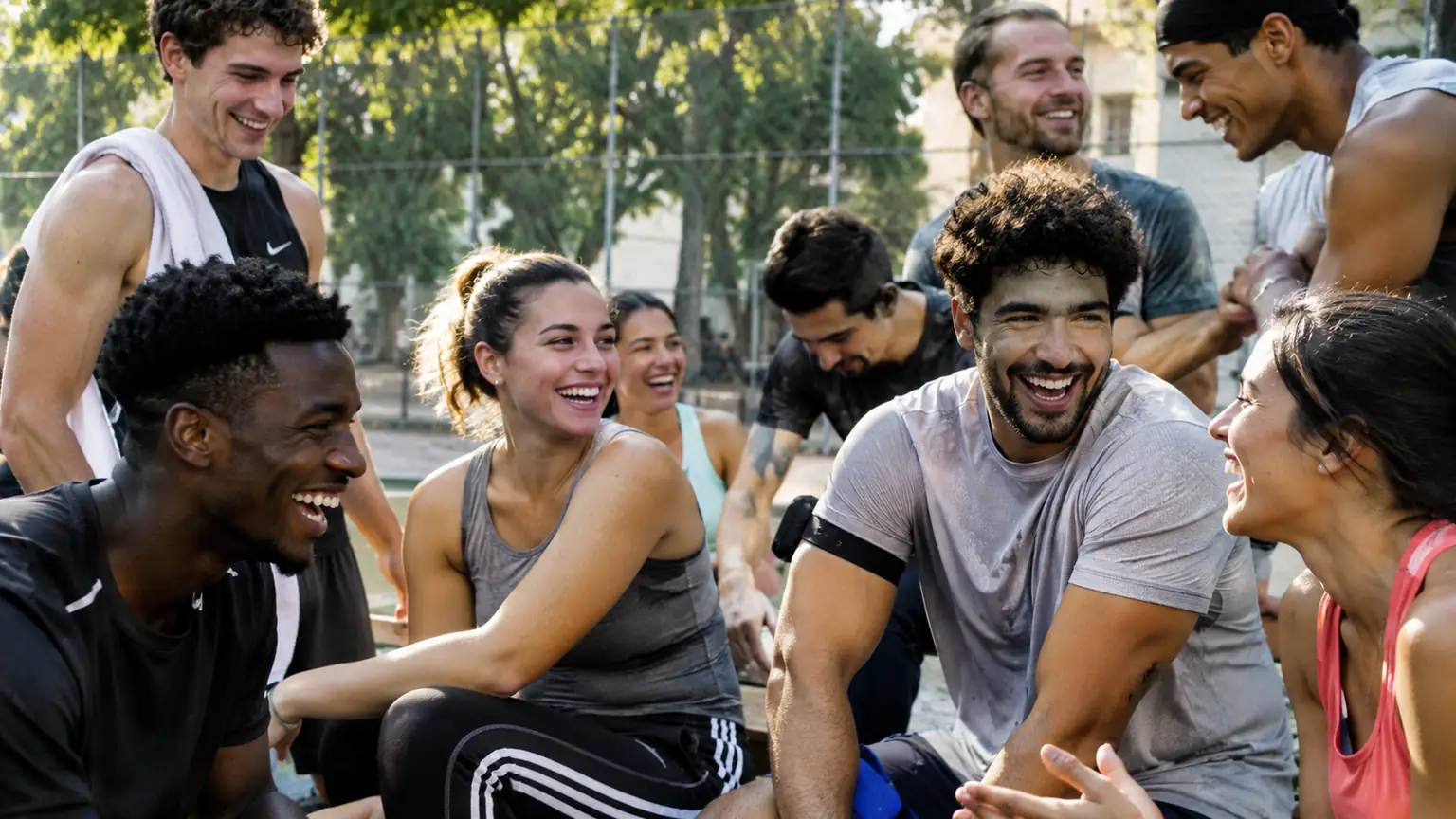
Editorial illustration using an original Sportive Minds photograph featuring fictional people; not documentary reporting or endorsement.