
Volleyball / Sports figure
Rosanna Baiardo
Rosanna Baiardo became the first Sardinian woman to represent Italy at senior international level in volleyball. A middle blocker from Sassari, she earned 119 national-team appearances between 1981 and 1988 and was part of Italy’s gold-medal squad at the 1983 Mediterranean Games. Her story continues through teaching, coaching and the development of opportunities for young athletes in Sardinia.
A fuller biography: the person behind the results, the world they grew up in, the decisions they made, and the legacy left beyond competition.
The early years: family, home and childhood
Rosanna Baiardo was born in Sassari in 1962. Public sports records describe her early volleyball development with Silvio Pellico, where coach Giampaolo Galleri helped her establish a role as a middle blocker. That local setting matters: national opportunities were much less accessible to a young player from Sardinia than to someone already established in a major mainland club. The record does not justify inventing conversations at home, childhood promises or private family details. What is known is that she learned the sport in Sassari while continuing her education and built a sufficiently strong reputation to attract national attention before her debut in Serie A.
Growing up in a changing world
Italian women's volleyball in the early 1980s was still developing the structures, visibility and competitive depth it would acquire in later decades. Baiardo's rise occurred in a context in which a player from an island club could face extra travel and scouting barriers. Her selection for the national programme in 1981 challenged expectations because she had not followed the usual top-flight route. She belonged to a generation whose international performances should be understood on their own terms, rather than judged only against the Olympic and world titles won by later Italian teams. She balanced athletic work with formal studies in physical education, a combination that would shape her subsequent working life.
The people and relationships behind the career
Coach Giampaolo Galleri is a documented figure in Baiardo's early sporting formation at Silvio Pellico. National coach Antonio Giacobbe provided another decisive professional connection when he called her into the senior squad in 1981. These are coaching relationships known through public biographical records, not grounds for imagining personal conversations. Years later, Baiardo became part of the public celebration of Alessia Orro's emergence. A 2015 newspaper account places her among those welcoming the young athlete after an under-18 world title, a moment that symbolises continuity between different generations of Sardinian women's volleyball. It is important not to mistake that generational connection for a documented coaching relationship unless a source establishes one.
The choices that changed the course of a life
The first clear turning point was the 1981 senior national-team call-up. The selection immediately placed a Sassari-based athlete into a new level of competition, leading to the 1982 World Championship in Peru and then the gold medal at the Mediterranean Games in Casablanca in 1983. Moving to the Naples area brought new club challenges and an opportunity to continue physical-education studies. Her career included an injury and a return to elite play, an experience described in the Sardinian sports archive. A further turning point came in 1988, when she chose to return to Sassari after periods in mainland clubs. The decision shifted the focus of her work toward the regional game and eventually youth sport.
What the public did not see in the sporting work
Baiardo played as a middle blocker, a position whose visible moments include blocking and quick attacks, but whose demands also involve reading the opposing setter and coordinating with teammates. Her 119 national appearances show sustained selection over multiple seasons, not just a one-off tournament. The evolution from player to coach and educator changed the nature of her responsibility: she was no longer judged solely by performance on court, but by the opportunities and learning environments created for others. Those broader observations are about the documented demands of her roles, not claims about a psychological method or private philosophy that has not been sourced.
Life beyond the arena
After returning to Sassari, Baiardo continued to connect physical education with organised sport. The Museo dello Sport Sardo records a long teaching career and her role in the formation of Junior Volley in 1994 and a sports education association in 2010. Those initiatives emphasised young participants and access to movement and team sport. The account also records recognition by the Panathlon Club Sassari in 2019. A life spent teaching and organising cannot be measured solely in trophies, yet such work is central to whether sporting traditions survive locally. Her public role demonstrates how a former national player can contribute to school sport and community structures over decades.
What remains of the personal journey
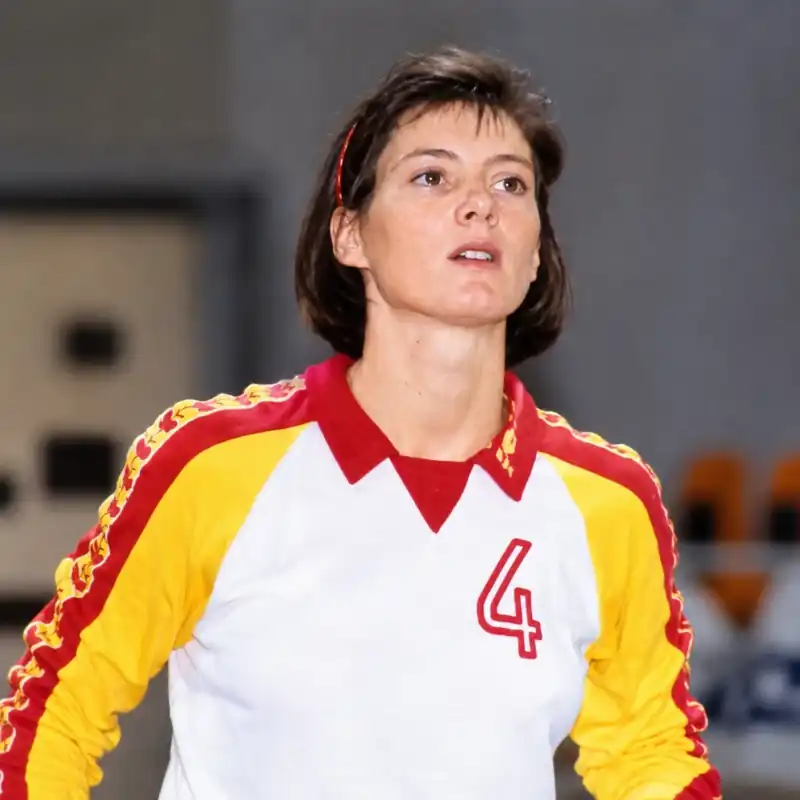
Baiardo's story connects island identity with an international sporting career. The achievements are specific: Italy's senior national team from 1981 to 1988, 119 appearances, participation in two World Championships and Mediterranean Games gold in 1983. The second half of the story concerns returning knowledge to the place where it began. For Sportive Minds, that makes her a useful figure for thinking about pathways, coaching and educational opportunity. The image on this page was supplied by the site owner and digitally re-created with AI; it is a visual reconstruction, not an unaltered archival photograph, and should not be used as forensic evidence of facial appearance or match details.
LIFE IN CONTEXT / THE ROAD SO FAR
A life, one turning point at a time.
Follow the documented moments that shaped Rosanna Baiardo — from the early years through defining personal and sporting milestones.
Born in Sassari, Sardinia
Selected for Italy's senior women's national volleyball team
Competes at the Women's Volleyball World Championship in Peru
Wins Mediterranean Games gold with Italy in Casablanca
Moves to the Naples area while combining volleyball and studies
Continues top-flight club volleyball in Reggio Calabria
Takes part in the World Championship
Returns to Silvio Pellico Sassari after mainland club seasons
Develops a youth volleyball organisation in Sassari
Establishes a school-and-sport initiative focused on young participants
Recognised by the Panathlon Club Sassari
Dates and life stages reflect the available sources. An undated childhood stage is not presented as an exact year.
THE SPORTING STORY
Career and achievements
Born in Sassari in 1962, Baiardo developed at Silvio Pellico under coach Giampaolo Galleri before Antonio Giacobbe called her into the Italian national team in 1981, when she had not yet played in the top division. She competed at the 1982 World Championship in Peru and formed part of the Italian side that won the women’s volleyball tournament at the 1983 Mediterranean Games in Casablanca. In that same period she moved to Centro Ester in the Naples area, combining higher-level competition with physical-education studies. Later senior club stops included Reggio Calabria and a Marche-region team, before her return to Sassari in 1988. She also took part in the 1986 World Championship. Contemporary and retrospective accounts record 119 senior international appearances across 1981–88. A 1988 Sardinian newspaper profile already described the choice to return home as a significant moment in island volleyball. After competitive play, she worked in physical education, coaching and sport administration, founding youth-oriented organisations in 1994 and 2010.
Rosanna Baiardo became the first Sardinian woman to represent Italy at senior international level in volleyball. A middle blocker from Sassari, she earned 119 national-team appearances between 1981 and 1988 and was part of Italy’s gold-medal squad at the 1983 Mediterranean Games. Her story continues through teaching, coaching and the development of opportunities for young athletes in Sardinia.
How they changed their sport
Her legacy is not only a national-team statistic. Baiardo crossed a barrier for women from Sardinia entering the Italian senior volleyball programme, and later helped keep pathways open within the island’s schools and clubs. The relationship between sporting achievement and education is unusually clear: she combined playing with study, then used her experience as a teacher and organiser. Her later public support for Alessia Orro, another Sardinian who reached international level, illustrates a line between generations rather than a claim that one person created the other’s success. For coaches, she represents the practical importance of regional access, resilience after injury and investment in young people.
Sources and further reading
Official sports archive ↗Personal history and primary references
- Museo dello Sport Sardo — Rosanna Baiardo biography and career
- CONI — Historical Mediterranean Games volleyball gold medallists
- La Nuova Sardegna — Rosanna Baiardo and Alessia Orro, August 2015
- Il Messaggero Sardo — Contemporary report on her return to Sassari in 1988
These sources support the reported biographical details. Where several accounts differ, this independent editorial portrait uses only shared, verifiable facts.
Independent editorial coverage. This is not an official profile and does not imply endorsement, membership, representation, commercial involvement or partnership with Sportive Minds.